Skip to content

For most commercial cargo, shipping from USA to China comes down to a simple trade-off: ocean freight is the cheapest way to move volume and air freight is the fastest way to move value. A full container (FCL) on a direct trans-Pacific service moves port to port in roughly 14 to 20 days, while air freight from a major US gateway to Shanghai or Beijing clears in 3 to 7 days door to door. The dominant cost driver is not the headline rate, it is chargeable weight and density: ocean is priced per container or per cubic meter (cbm), air is priced per kilogram of chargeable weight, and that single distinction decides which mode wins for your shipment.
If your consignment is heavy, bulky or not time-sensitive, ocean wins on landed cost almost every time. If it is light, high-value or urgent, air pays for itself by freeing up working capital and meeting a deadline. ExFreight handles both ends of that decision: see air freight from the USA to China for time-critical shipments, and freight forwarding from the USA to China for full ocean and door-to-door management. The table below summarizes the four modes at a glance.
| Mode | Typical transit (door to door) | Cost basis | Best for |
|---|---|---|---|
| Ocean FCL | 20 to 32 days | Per 20ft / 40ft container | Full or near-full loads, heavy or bulky cargo |
| Ocean LCL | 25 to 38 days | Per cbm (or per 1,000 kg, whichever is greater) | Part loads roughly 2 to 13 cbm |
| Air freight | 4 to 8 days | Per kg chargeable weight | Urgent, high-value, light or dense cargo |
| Express | 2 to 5 days | Per kg, all-in door to door | Small parcels, samples, documents |
Shipping methods from USA to China compared
The four practical ways to ship from the United States to China sit on a clear spectrum of speed versus cost. Ocean FCL is the workhorse for anything that fills, or nearly fills, a container. Ocean LCL lets you share a container and pay only for the space you use, which makes sense for part loads. Air freight collapses transit to under a week and is the default for electronics, machinery parts, pharmaceuticals and anything where a deadline or shelf life matters. Express (integrator parcel service) is for small, urgent consignments where door-to-door simplicity beats unit economics.
The decision rule is mechanical. Calculate your chargeable weight for air (the greater of actual weight or volumetric weight, where volumetric kg equals length times width times height in centimeters divided by 6,000). Compare the all-in air cost against the all-in ocean cost for the same goods. For dense, heavy cargo the ocean number is usually a fraction of the air number; for light, voluminous cargo the gap narrows and air can become competitive once you factor in inventory carrying cost, insurance and the value of arriving weeks earlier. Density (kg per cbm) is the variable that flips the answer, so measure and weigh accurately before you book.
Ocean freight from the USA to China
Ocean is the backbone of the USA to China lane. Exports typically load at the largest US container gateways: Los Angeles and Long Beach (which together handle the bulk of West Coast container traffic), Oakland (a major West Coast agricultural export hub), New York and New Jersey on the East Coast, Savannah (the fastest-growing East Coast port), and Houston on the Gulf. On the import side, Chinese cargo discharges at the world’s busiest box ports: Shanghai (around 49 million TEU a year, the largest container port on earth), Ningbo-Zhoushan (around 35 million TEU), Shenzhen in the south (around 30 million TEU), Qingdao in the north, and Tianjin serving the Beijing-Tianjin region.
West Coast departures are the fastest to North and East China. Port to port, Los Angeles or Oakland to Shanghai runs roughly 14 to 20 days on a direct service; East Coast and Gulf departures (New York, Savannah, Houston) to Shanghai or Ningbo run longer, often 28 to 40 days, because they route via the Panama Canal or transship in Asia. Add origin pickup and destination delivery and door-to-door FCL typically lands at 20 to 32 days from the West Coast and 30 to 45 days from the East Coast and Gulf.
Indicative 2026 ocean rate ranges (these are market ranges for planning, not quotes) run roughly 1,200 to 3,000 USD for a 20ft and 2,000 to 4,500 USD for a 40ft / 40HQ on the headhaul leg, with surcharges, terminal handling, documentation and inland haulage adding several hundred to over a thousand dollars per container. Rates are volatile and rise sharply in peak season and around Chinese New Year, so book early. LCL is priced per cbm (or per metric ton, whichever is greater), with indicative ranges around 30 to 70 USD per cbm plus fixed origin and destination charges. The practical break-even between LCL and FCL on this lane sits around 13 to 15 cbm: below that, LCL usually wins; above it, a 20ft FCL is normally cheaper and faster because it skips deconsolidation. For the full decision logic, read the air freight vs ocean freight decision framework.
Air freight from the USA to China
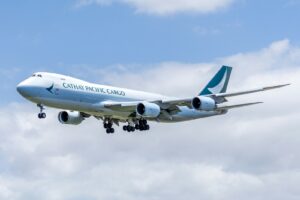
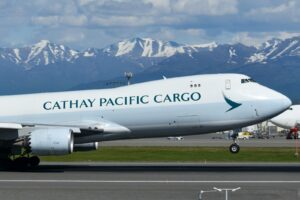
Air freight from the USA to China moves through the major US cargo gateways: Chicago O’Hare (ORD), New York JFK, Los Angeles (LAX), Atlanta (ATL) and Dallas Fort Worth (DFW). The main Chinese arrival airports are Shanghai Pudong (PVG, the country’s leading cargo hub), Beijing Capital (PEK) and Daxing (PKX), and Guangzhou Baiyun (CAN) in the south. Direct flight time from the US West Coast to Shanghai is around 11 hours and from the East Coast around 13 to 14 hours, but the figure shippers should plan around is total transit including pickup, build-up, customs and delivery.
Realistic door-to-door air transit is 3 to 5 days from the West Coast (LAX to PVG) and 4 to 8 days from the East Coast and interior (JFK, ORD, ATL, DFW). Air is priced per kilogram of chargeable weight; indicative 2026 trans-Pacific rates range from roughly 3.50 to 7.00 USD per kg and higher depending on capacity, lane, fuel and security surcharges, with peak season (Q4) and Chinese New Year pushing the top of the range up. Air beats ocean when the goods are high-value relative to weight (so the freight is a small share of product cost), when a deadline or shelf life is in play, or when faster delivery meaningfully reduces inventory and working-capital cost. For dense, low-value cargo, ocean remains far cheaper per unit landed.
US export clearance and documents
Every export from the United States to China must satisfy US export rules before it leaves. The central obligation is Electronic Export Information (EEI), filed electronically through the Automated Export System (AES) in ACE. EEI filing is required when the value of goods classified under a single Schedule B number exceeds 2,500 USD, or whenever the shipment requires an export license regardless of value. The US Principal Party in Interest (USPPI), or an authorized agent such as your forwarder, prepares the EEI and provides the proof of filing (the Internal Transaction Number) for the loading documents. Guidance is published by the International Trade Administration at trade.gov and US Customs and Border Protection at CBP.
Classification drives compliance. Each commodity needs a Schedule B number (from the US Census Bureau) for the AES filing, and an Export Control Classification Number (ECCN) under the Export Administration Regulations (EAR), administered by the Bureau of Industry and Security. China is a destination where additional EAR controls apply, so dual-use items, technology and certain electronics can require a license or specific filings even when they would ship freely elsewhere. Screen your product and your buyer before booking: confirm the ECCN, check the Commerce Control List and the relevant license requirements, and screen all parties against the restricted-party lists.
The core export document set is the commercial invoice, the packing list, the bill of lading (ocean) or air waybill (air), and a certificate of origin where the importer or a trade agreement requires it. Your chosen Incoterms 2020 rule decides who pays freight, insurance, export clearance and import duties, and where risk transfers, so agree the term in writing before production. A common starting point on this lane is FOB at the US load port; if you are quoting or negotiating FOB, read the complete guide to FOB shipping terms so the cost and risk split is unambiguous.
China import customs, duties and VAT
On arrival, goods clear through the General Administration of Customs of the People’s Republic of China (GACC). A China customs declaration must be lodged by a Chinese-incorporated entity holding a Customs Registration Code: the importer of record must be a domestic Chinese company, so a US exporter selling on delivered terms needs a local importer or an importer-of-record arrangement. Official guidance is published at China Customs (GACC).
For the complete document checklist and duty rules, see China customs clearance requirements.
Import charges stack on the CIF dutiable value (cost plus insurance plus freight). First, customs duty equals CIF multiplied by the applicable tariff rate for the product’s HS code. Second, import VAT equals (CIF plus duty) multiplied by 13 percent for most goods, with a reduced 9 percent rate on certain categories such as many agricultural products. Third, consumption tax applies to a defined list of goods (for example alcohol, tobacco, certain cosmetics, fuel and some vehicles) and is calculated on a tax-inclusive basis at product-specific rates. Get the HS classification right, because it sets both the duty rate and any regulatory flags. The HTS code classification guide walks through how to find the correct tariff number, and the landed cost guide shows how to combine duty, VAT and freight into a single delivered cost.
Two compliance layers catch shippers out. CIQ inspection (the customs inspection and quarantine function now under GACC) is assigned on arrival by channel: a green channel clears automatically, yellow triggers documentary review, and red adds a physical examination, so having every certificate ready before arrival is what keeps cargo moving. Separately, China Compulsory Certification (CCC) is a hard market-access requirement for products in the regulated categories (many electrical, electronic, automotive and safety-related goods): without the CCC mark, covered goods cannot legally clear. Check whether your product is in scope before you ship, and prepare the standard document set: commercial invoice, packing list, bill of lading or air waybill, certificate of origin, and the CCC certificate or any product-specific approval where required.
Transit times USA to China
The table below sets realistic door-to-door planning ranges by mode and origin region. Treat them as planning windows, not guarantees: weather, port congestion, customs channel assignment and peak-season capacity all move the actual number.
| Mode and origin | Port/airport to port/airport | Door to door |
|---|---|---|
| Ocean FCL, US West Coast (LA, Long Beach, Oakland) | 14 to 20 days | 20 to 32 days |
| Ocean FCL, US East Coast and Gulf (NY/NJ, Savannah, Houston) | 28 to 40 days | 30 to 45 days |
| Ocean LCL (consolidation adds handling) | +5 to 8 days vs FCL | 25 to 45 days |
| Air freight, US West Coast (LAX to PVG) | 1 to 2 days flight and handling | 3 to 5 days |
| Air freight, US East Coast and interior (JFK, ORD, ATL, DFW) | 2 to 3 days flight and handling | 4 to 8 days |
| Express parcel | n/a | 2 to 5 days |
How to lower your USA to China shipping costs
Most savings on this lane come from a handful of disciplined moves rather than from chasing the lowest headline rate.
- Match the mode to the cargo. Run the chargeable-weight comparison every time. Do not air-freight dense goods that ocean moves for a fraction of the cost, and do not ocean-ship a deadline-critical part that will idle a production line for three weeks.
- Consolidate toward full containers. If you are regularly shipping above the LCL break-even (roughly 13 to 15 cbm), a 20ft FCL is usually cheaper per unit and faster than LCL because it avoids deconsolidation.
- Optimize packing and density. Tighter, palletized loads reduce both volumetric weight for air and cbm for LCL. A small reduction in dimensions can move you below a chargeable-weight threshold.
- Book ahead of peak season. Rates and the risk of rollovers climb in Q4 and before Chinese New Year. Locking space early protects both cost and transit.
- Classify correctly and once. The right HS and Schedule B codes avoid duty overpayment, customs holds and penalties, all of which cost far more than the time to classify properly.
- Pick the right Incoterm. Controlling the main leg (for example shipping FOB at origin and arranging your own freight) often beats accepting a counterparty’s marked-up freight built into a delivered price.
Common mistakes shipping from the USA to China
- Skipping or mis-filing the EEI. Filing in AES is mandatory above the 2,500 USD per-Schedule-B threshold or whenever a license is required; a missing or wrong Internal Transaction Number stops the cargo and exposes the exporter to penalties.
- Ignoring EAR controls to China. China is a controlled destination for many dual-use items. Assuming a product ships license-free because it does elsewhere is a frequent and costly error.
- No Chinese importer of record. Customs requires a domestic entity with a Customs Registration Code. Shipping on delivered terms without a local importer in place leaves cargo stuck at the border.
- Overlooking CCC. Many electrical, electronic and automotive products cannot clear without the CCC mark. Confirm scope before production, not after the container has sailed.
- Wrong HS classification. The HS code sets the duty rate, the VAT treatment and any inspection flags. A guess can mean overpaid duty, a red-channel exam, or a clearance hold.
- Underestimating landed cost. Quoting only the freight rate ignores duty, 13 percent VAT, consumption tax where it applies, terminal and documentation charges, and inland delivery. Always model the full delivered number before you commit.
Ship from the USA to China with ExFreight
Whether you are moving a single pallet or a full container program, the same logic applies: pick the mode that fits the cargo, classify and file correctly on the US side, and line up duty, VAT and the importer of record on the China side before anything sails. ExFreight manages all of it. For urgent, high-value cargo use air freight from the USA to China; for full ocean and door-to-door programs use freight forwarding from the USA to China. To compare lanes, modes and other destinations, start from the ExFreight USA shipping hub, get an instant online quote, and book the option that lands your goods in China at the lowest total cost.
Frequently asked questions
How long does shipping from the USA to China take?
Ocean FCL runs about 20 to 32 days door to door from the US West Coast and 30 to 45 days from the East Coast and Gulf. Air freight is far faster at 3 to 8 days door to door, and express parcel is 2 to 5 days.
How much does it cost to ship from the USA to China?
As an indicative 2026 planning range, an ocean 40ft container runs roughly 2,000 to 4,500 USD plus surcharges, LCL around 30 to 70 USD per cbm, and air freight roughly 3.50 to 7.00 USD per kilogram of chargeable weight. These are market ranges, not quotes, and they move with season and capacity.
Do I need to file EEI in AES to export from the USA to China?
Yes, if the value of goods under a single Schedule B number exceeds 2,500 USD, or if an export license is required for any value. The filing is made in the Automated Export System by the USPPI or an authorized agent such as your freight forwarder.
What import taxes does China charge on US goods?
China stacks customs duty on the CIF value, then import VAT of 13 percent for most goods (9 percent on some categories like many agricultural products), and consumption tax on specific goods such as alcohol, tobacco and certain cosmetics. The duty rate depends on the product’s HS code.
What documents are required to import into China?
The standard set is the commercial invoice, packing list, bill of lading or air waybill, and a certificate of origin. Products in regulated categories also need China Compulsory Certification (CCC), and a Chinese importer of record with a Customs Registration Code must lodge the declaration.
Should I choose air or ocean freight to China?
Compare chargeable weight against container or cbm cost. Dense, heavy or non-urgent cargo is far cheaper by ocean, while light, high-value or deadline-driven cargo usually justifies air once you factor in faster delivery and lower inventory cost.
Ready to ship? Get an instant freight quote.