Skip to content

A freight shipping API for e-commerce is a connection that lets a storefront, OMS or ERP price, book and track palletized or oversized orders that parcel rates cannot cover.
Parcel APIs work well until a B2B order outgrows a box. A distributor buys 18 cartons of fixtures, a dealer orders a crated machine, or an overseas customer wants three cartons sent to Germany, and the checkout either shows a parcel price that cannot cover the move or no price at all. A freight connection such as the ExFreight freight API closes that gap by returning LTL, FTL, air and ocean options from the same order data your platform already holds. This guide covers where freight and parcel logic split, which SKU data you need before you go live, and what happens after the buyer clicks “place order”.
Key takeaways
- Route orders by weight, dimensions and handling unit, not by product category: one cart can need parcel, small parcel export or LTL.
- Freight rates depend on dimensions, density and delivery conditions, so SKU master data decides whether the checkout price holds.
- Treat the checkout figure as an estimate: re-quote with final pallet data before booking, then track to delivery.
Parcel API vs freight API at checkout
A parcel API prices individual packages against a carrier’s zone and dimensional-weight tables. A freight API prices a shipment: one or more handling units moving under a single bill of lading, with rates driven by weight, density, distance, mode and accessorial services. The data model is different, and so is the moment of truth. A parcel label is usually final at print time; a freight rate depends on how the order is built into pallets in the warehouse.
| Parcel API | Freight API | |
|---|---|---|
| Unit priced | Each package | The shipment (pallets, crates, cartons on one bill of lading) |
| Main rate drivers | Zone, actual vs dimensional weight | Weight, dimensions, density or freight class, lane, mode |
| Delivery conditions | Mostly standard; residential surcharge | Dock, residential, liftgate, limited access, appointment, each priced separately |
| Modes returned | Ground and air parcel | LTL, volume LTL, FTL, air, ocean FCL/LCL |
| When the price firms up | At label creation | After pallet build, at booking; adjusted if actual details differ |
| Typical buyer | Consumers, small reorders | Distributors, dealers, contractors, wholesale accounts |
Operator tip: do not ask the buyer to choose “freight” or “parcel”. Let the order system decide with a rule set (total weight, longest side, number of cartons, any SKU flagged ships-on-pallet) and show the buyer one clear delivery option with a transit estimate.
Small parcel under 150 lbs vs palletized LTL
Between the consumer parcel and the full pallet sits a band of B2B orders that cause most checkout errors. Most parcel networks cap a single package at 150 lbs, and a stack of loose cartons above that point is cheaper and safer on a pallet. For export orders, ExFreight runs an international small parcel service for business-to-business cargo under 150 lbs that is not palletized, door to door, rated and booked on the ExFreight platform. Bookings default to DAP, so the consignee pays duties and taxes at destination; DDP requires a manual booking through Customer Service. HTS codes, values and country of origin must be correct at booking, because they go to customs at origin and destination and cannot be edited afterward.
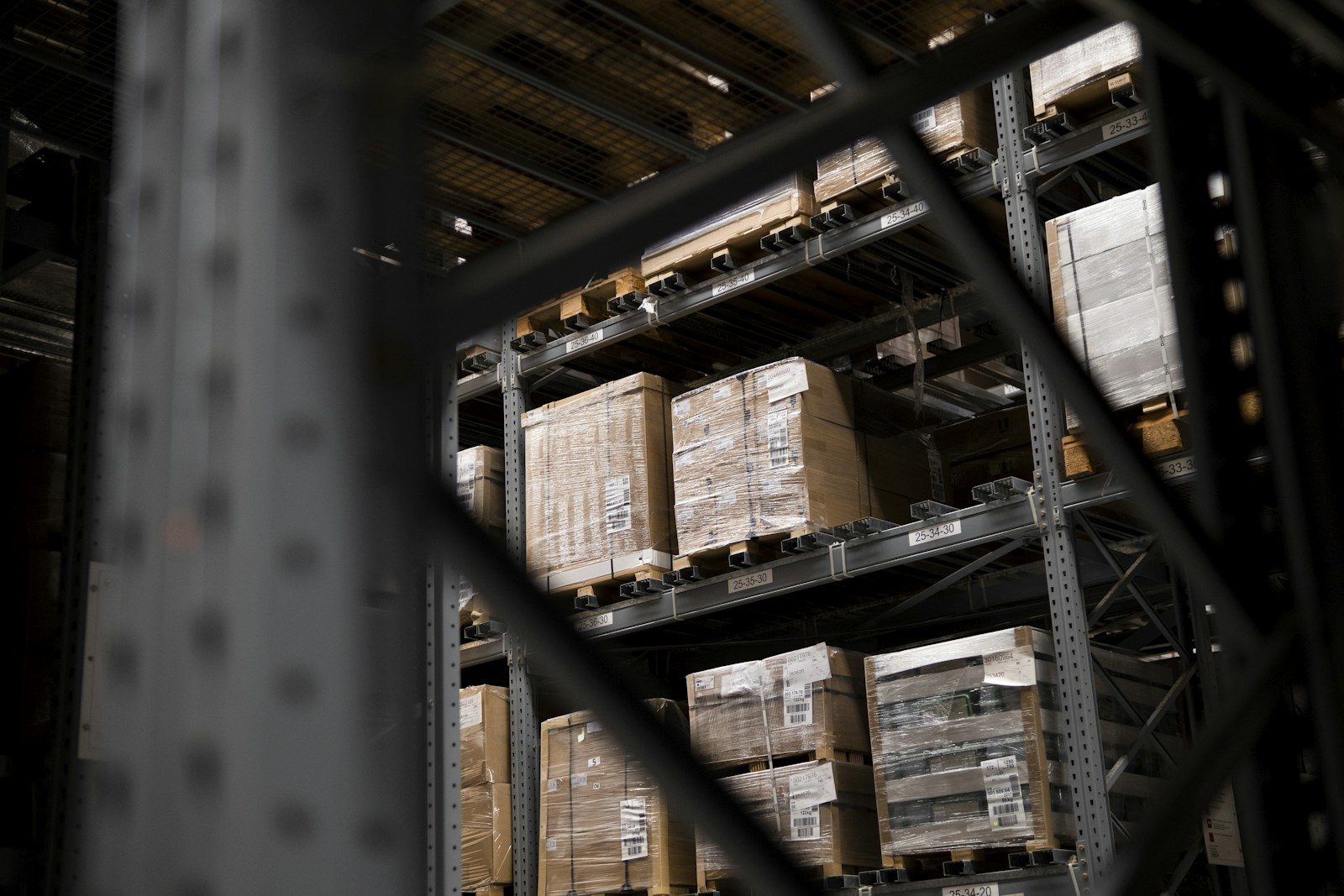
Once the order is palletized, it belongs in LTL freight for domestic moves. LTL pricing rewards accurate dimensions: ExFreight uses density-based LTL pricing, and when shippers provide accurate weight and dimensions the system protects them from many of the reclassification charges that hit mis-described freight.
Worked example: one catalog, two shipping paths
A lighting distributor sells a fixture packed in a 24 x 18 x 12 in carton weighing 22 lbs.
- Order A, export: 3 cartons (66 lbs) to a reseller in Germany. Under 150 lbs, not palletized, B2B: this fits international small parcel. The order system must pass the HTS code, the per-line value and the country of origin with the booking.
- Order B, domestic: 18 cartons (396 lbs) to a contractor in Ohio. On a 48 x 40 in pallet, four cartons fit per layer, so 18 cartons need five layers: 60 in of cartons plus about 6 in of pallet, or 66 in tall. With a 45-lb pallet the handling unit weighs about 441 lbs and occupies 48 x 40 x 66 in, or 73.3 cubic feet. Density is about 6 lbs per cubic foot.
The pitfall in Order B: if the storefront sums carton weights (396 lbs) and sends carton dimensions, the quote describes freight that will never exist. The carrier measures a 441-lb pallet at 66 in, and the invoice follows the pallet. Build the handling unit in code before you request the rate.
Prerequisites: SKU dimensions, accessorials and freight class
Most failed freight checkouts trace back to master data, not to the API call. Since NMFC Docket 2025-1 took effect on July 19, 2025, many more commodities are classed by density, and the National Motor Freight Traffic Association notes that handling unit dimensions and weight will be needed in most cases. Before you go live, make sure each SKU and each order carries the fields below.
| Field | Example | Why it matters |
|---|---|---|
| Carton dimensions and weight per SKU | 24 x 18 x 12 in, 22 lbs | Feeds the pallet-build logic and the density calculation |
| Ships-on-pallet / ships-alone flag | true | Forces freight routing for crated or oversized items |
| Stackable flag | false | Non-stackable freight takes more trailer space and may price higher |
| Commodity description and NMFC item (if known) | Lighting fixtures, boxed | Class or density basis for LTL rating |
| Delivery location type | Residential, business with dock, jobsite | Each one changes the accessorials on the quote |
| Liftgate and appointment needs | Liftgate at delivery | Undeclared services are added after delivery |
| HTS code, value, country of origin (export) | 9405.xx, $1,240, US | Required for customs filing on international orders |
Ask for delivery conditions at checkout in plain language: “Does the delivery address have a loading dock?” is a better question than a checkbox labeled “liftgate”. If the answer is no, the order needs a liftgate delivery priced into the rate, not discovered by the driver. Note also that ExFreight’s small parcel service does not handle dangerous goods, hazardous materials or perishables, so a hazmat flag on the SKU should block that path.
Freight quotes are informational and subject to change; shipments can be re-invoiced if actual details differ. Weight, dimensions, delivery type and accessorials declared at checkout must match what the carrier finds at pickup and delivery. Re-quote with the built pallet before booking, and store both figures on the order for reconciliation.
Booking and tracking after checkout
Checkout produces an order, not a shipment. The handoff from storefront to freight booking is where an API saves the most labor, because nobody has to retype addresses, contacts and handling units into a portal. A typical post-checkout flow looks like this:
- Release. The OMS releases the order to the warehouse when payment clears.
- Build and re-quote. The warehouse confirms pallet count, dimensions and weight; the system requests a fresh rate with final data.
- Book. The selected option is booked through the API, and the confirmation number is written back to the order.
- Track. Tracking status is pulled on a schedule and mapped to the customer-facing order page, so buyers can self-serve instead of opening “where is my order” tickets.
- Close. Delivery status triggers invoicing logic and flags any variance between quoted and invoiced freight for review.
The LTL rate API guide covers the request fields for step 2 in more detail. For buyers, the most useful tracking change is mapping carrier events to three or four plain statuses (booked, picked up, in transit, delivered) rather than exposing raw carrier codes.
What ExFreight’s API covers today
The APIs are available upon request, with a test environment and assistance from the ExFreight team. Connectivity gives access to ExFreight’s online rating, booking and tracking system, and existing TMS integrations include Project 44, Accufrate, Banyan, SAAS, 7L, Primus, Pacejet, CSA Software and Teknowlogi. See how the ExFreight freight API works
Choosing a freight shipping API for e-commerce
There are three common patterns. A parcel-only storefront with manual freight quotes works at low volume but slows wholesale buyers and hides margin leaks. A multi-carrier aggregator adds breadth but still needs clean pallet data to price freight correctly. A direct connection to a freight forwarder’s rating, booking and tracking system suits shippers whose orders mix domestic LTL with international air and ocean, because one multimodal integration returns both. Whichever pattern you choose, the decision rule is the same: price the shipment you will actually tender. If your order data cannot describe a pallet, fix the data first and then connect the API.
Freight API series
Frequently asked questions
What is a shipping API for e-commerce?
A shipping API for e-commerce connects a storefront, OMS or ERP to carriers or forwarders so the platform can request rates, book shipments and retrieve tracking without manual entry. Parcel APIs price individual packages; freight APIs price palletized or oversized shipments by weight, dimensions, density, lane and accessorial services such as liftgate or residential delivery.
Which API is best for e-commerce?
The best API matches your order profile. Consumer orders in single boxes fit a parcel API. B2B orders that ship on pallets, in crates or internationally need a freight API that returns LTL, FTL, air and ocean options. Many shippers run both, with order rules deciding which one prices each cart.
What is an e-commerce API?
An e-commerce API is an interface that lets other software read or write store data such as products, inventory, orders, customers and payments. Shipping integrations use it to pull paid orders into a shipping system, then write back rates, booking confirmations and tracking status so buyers see delivery progress on the order page.
What are the 6 types of APIs?
A common way to list six API types is by architecture: REST, SOAP, GraphQL, gRPC, WebSocket and webhook-based event APIs. APIs are also grouped by access: open, partner, internal and composite. Freight connections are typically partner APIs, granted on request, with a test environment before production access.