Skip to content

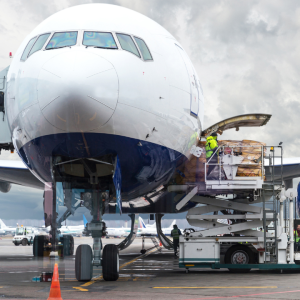
Air freight charges are calculated on chargeable weight, defined as the greater of actual gross weight (kg) and volumetric weight (kg). The IATA volumetric formula divides L cm by W cm by H cm and then by 6000, producing the volumetric kilograms. A density threshold of 167 kg/m³ separates dense cargo (charged on actual weight) from low-density cargo (charged on volumetric weight). Rate per kg on main lanes such as China to US and EU to US sits between $3.00 and $8.00, while specialty and short-haul lanes run $5 to $15 per kg under the IATA TACT (The Air Cargo Tariff) categories.
Chargeable weight: the formula carriers actually use
Every Master Air Waybill (MAWB) and House Air Waybill (HAWB) prices freight on chargeable weight, not on what the scale shows. The rule is short:
- Chargeable weight = MAX(actual weight kg, volumetric weight kg)
- Volumetric weight kg = (L cm × W cm × H cm) / 6000
The 6000 divisor is the IATA standard. It encodes a density of 167 kg per cubic meter. Cargo denser than 167 kg/m³ (machinery, metal parts, dense liquids in drums) is charged on actual weight. Cargo lighter than 167 kg/m³ (apparel, foam, empty plastic enclosures) is charged on volumetric weight because it consumes more aircraft space than its scale weight suggests.
Worked example 1: dense cargo
A pallet of automotive parts weighs 100 kg actual. Dimensions are 100 × 80 × 60 cm.
- Volume = 100 × 80 × 60 = 480,000 cm³
- Volumetric weight = 480,000 / 6000 = 80 kg
- Chargeable weight = MAX(100, 80) = 100 kg
- At $5.00 per kg main-lane rate: 100 × $5.00 = $500 base freight
Surcharges (fuel, security, handling) are added separately, not folded into the per-kg rate.
Worked example 2: low-density cargo
A wooden crate of inflatable products weighs 50 kg actual. Dimensions are 120 × 80 × 100 cm.
- Volume = 120 × 80 × 100 = 960,000 cm³
- Volumetric weight = 960,000 / 6000 = 160 kg
- Chargeable weight = MAX(50, 160) = 160 kg
- At $5.00 per kg: 160 × $5.00 = $800 base freight
Three times the actual weight ends up on the invoice because the crate occupies the cubic capacity of 160 kg of dense cargo. This is why packaging optimization (tighter cartons, removing void fill) directly reduces the chargeable weight on air freight shipments.
Surcharges: every line on the air freight invoice
The base rate per kg is one component. Carriers add separate surcharges on the MAWB and forwarders pass them through on the HAWB.
- Fuel Surcharge (FSC): indexed to jet fuel prices, recalculated weekly or monthly by the carrier.
- Security Surcharge (SSC): covers regulated cargo screening, X-ray, and EDD checks.
- War Risk Surcharge: applied on lanes routed near active conflict zones.
- Peak Season Surcharge (PSS): typically August through October, when capacity tightens before holiday retail.
- Dangerous Goods Surcharge: 50% to 200% premium for IMO/IATA DG cargo, depending on UN class.
FSC and SSC together can add $0.80 to $2.50 per kg on top of the base rate, sometimes more on long-haul intercontinental segments.
Pickup, handling, and customs: fees outside the per-kg rate
Air freight rate quotes are usually airport to airport. The full door-to-door cost includes:
- Pickup and Delivery (PUD): origin trucking from shipper to airport, destination trucking from airport to consignee.
- Terminal Handling Charge (THC): airline ground handling at origin and destination.
- AWB fee: documentation fee for issuing the air waybill.
- Screening fee: per-kg charge for TSA/regulated cargo screening at origin.
- Customs clearance fee: separate line, typically $75 to $300 per entry depending on complexity and number of HTS lines.
ULDs and aircraft type: how capacity shapes the rate
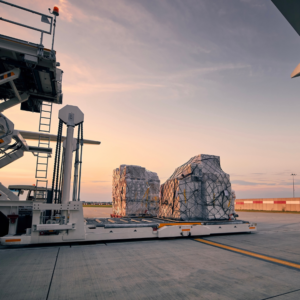
Cargo loads into Unit Load Devices (ULDs). The size of the ULD and the aircraft type determine how a forwarder buys capacity from the airline.
- LD3 (AKE): ~1.5 m³ container, used in B777, A330, A350 lower decks.
- LD7 (PMC pallet): 4 to 5 m³, the workhorse main-deck and lower-deck pallet.
- M1 / full pallet position: a full main-deck position on a freighter.
Dedicated freighters (B777F, B747F, B767F, A330F) carry larger ULDs and full main-deck positions. Belly capacity on passenger aircraft (B777, A350, B787) is cheaper but limited and shares space with passenger luggage. When passenger flights drop on a lane, belly capacity shrinks and rates climb. For background on whether full ocean containers can be shifted to air, see can you air freight a container.

Lane economics: why China to US runs $3 to $8 per kg
Origin, destination, and routing drive the base rate. Three patterns repeat:
- Main lanes (China to US, EU to US): $3.00 to $8.00 per kg. High volume, multiple daily freighter rotations, competition between SkyTeam, Star Cargo, and independent freighter operators.
- Specialty and short-haul: $5 to $15 per kg. Fewer flights, smaller aircraft, higher per-kg cost.
- Backhaul: the return leg of a freighter rotation, often discounted to fill space.
Transit time on China to US air freight typically runs 3 to 8 days door to door depending on routing and clearance. See how long shipping from China to the US takes for the full breakdown, and fastest shipping options for businesses for next-flight-out and consolidator timelines.
MAWB vs HAWB: who issues what
Two air waybills travel with every shipment, and the difference between them is one of the most common sources of confusion on air freight invoices.
- Master Air Waybill (MAWB): issued by the airline, covers the full consolidation from origin airport to destination airport, references the airline IATA prefix and a serial number.
- House Air Waybill (HAWB): issued by the forwarder, covers the individual shipper-to-consignee shipment inside the consolidation, references the forwarder.
Forwarders consolidate multiple HAWBs under one MAWB to buy bulk capacity at a lower per-kg rate, then bill each shipper on the HAWB. This is why a forwarder quote often beats a direct airline quote on small shipments below 500 kg, where individual airline tariffs are highest.
Door-to-door or airport-to-airport: how service level changes the number
Airport-to-airport covers only the flight between cargo terminals. Door-to-door adds pickup at origin, export handling, import clearance and final delivery to the consignee. Door-to-door carries a higher shipment total because it bundles trucking, handling and clearance, and it is usually the better value once you price the cost and coordination of arranging those legs yourself.
The right choice depends on what you already have in place. With a customs broker and local trucking on both ends, airport-to-airport is enough. Without them, door-to-door removes the coordination burden and gives you one number covering the whole journey.
How to lower the chargeable weight
Three packaging decisions move chargeable weight directly:
- Right-size the carton: a 10 cm reduction on each dimension of a 100 × 80 × 60 cm box drops volume from 480,000 cm³ to 315,000 cm³, dropping volumetric weight from 80 kg to 52.5 kg.
- Cut void fill: air-fill bags and oversized cartons multiply volumetric weight without adding any product.
- Stack and shrink-wrap on a single skid: a consolidated skid is measured as one piece, eliminating wasted height between separate cartons.
For low-density cargo, packaging optimization can reduce the invoice by 20% to 40% before any rate negotiation.
Putting a quote together: a full-cost example
Shipment: 160 kg chargeable, China to US, main lane.
- Base freight: 160 kg × $5.00 = $800
- FSC: 160 kg × $1.20 = $192
- SSC: 160 kg × $0.15 = $24
- THC origin + destination: $90
- AWB fee: $35
- Customs clearance: $125
- Destination PUD: $140
- Total door to door: ~$1,406
The base rate is 57% of the invoice. Surcharges, handling, customs, and trucking are the other 43%. Comparing forwarder quotes on base rate alone misses where most of the cost actually sits.
Frequently asked questions
How much does an air freight forwarder cost?
There is no single flat price, because an air freight forwarder’s charge is built from your chargeable weight multiplied by the lane rate, plus fuel and security surcharges, handling, customs clearance, and any accessorials. The same shipment can cost very differently depending on route, timing, and service level. The most reliable way to know your number is to pull a live quote, where every component is calculated for your specific cargo and lane in real time.
Why do air freight costs vary so much between quotes?
Air freight costs vary between quotes because each forwarder may use different airlines, apply different surcharge levels, and include or exclude services like pickup, delivery, and clearance. A low headline rate often omits surcharges or accessorials that appear later on the invoice. Comparing quotes on a true all-in basis, where every line item is shown, is the only way to compare fairly and avoid hidden costs.
What is the difference between actual weight and chargeable weight?
Actual weight is the physical gross weight of your shipment on a scale, while chargeable weight is the greater of that actual weight and the volumetric weight calculated from the cargo’s dimensions, using (L × W × H in cm) ÷ 6000. Airlines bill on chargeable weight so they are paid for the aircraft space your cargo occupies. Bulky, lightweight shipments are almost always billed on volumetric weight.
Can I reduce my air freight forwarder costs?
Yes. You can reduce air freight costs by minimizing chargeable weight through tighter packaging and efficient palletizing, shipping outside peak-season windows, classifying commodities correctly to avoid customs delays, and choosing the service level that matches your needs. Comparing multiple airlines on the same lane also helps, which is exactly what a digital forwarder does automatically by sourcing live rates from many carriers at once.
Are fuel and security surcharges always included in the rate?
With a transparent forwarder, fuel and security surcharges are always shown and included in the all-in price you see at quote time. With less transparent providers, the headline rate may exclude them, and they appear later as separate charges. Always confirm whether a quote is all-in or base-only before comparing, because surcharges can materially change the total cost of the shipment.
Get an instant air freight quote
ExFreight’s digital platform prices chargeable weight, surcharges, customs, and PUD on one screen, with no rate request and no waiting for an email reply. Run your dimensions and weight at exfreight.com and book in minutes.