Skip to content


On Oct. 19, the advocacy group United Against Nuclear Iran published a shipping update on the Persian Gulf, the Strait of Hormuz and the Red Sea. It said the International Maritime Organization (IMO) had confirmed 114 incidents involving commercial vessels since the U.S. blockade of Iranian ports resumed on July 14. The group also reported 24 seafarer deaths.
Hormuz traffic and the blockade
According to the report, about 138 vessels used the Strait of Hormuz each day before the crisis. In October, transits facilitated by the U.S. along the southern corridor averaged 29.71 vessels a day, roughly 21% of that baseline.
The report said a U.S. escort program started on June 18. Since then, 1,681 vessels have crossed, an average of 21.98 a day over 120 monitored days. Other traffic is described as staying away, waiting at anchorages in the Indo-Pacific or sailing around the Cape of Good Hope.
Key figures cited for U.S. blockade enforcement since July 14:
- 138 commercial vessels redirected
- 4 ships disabled
- 2 ships boarded for compliance checks
- 10 tankers destroyed that were linked to the Islamic Revolutionary Guard Corps
The update said at least 53 tankers carrying Iranian crude and petroleum products were stuck near the Iranian coast. It also said no Iran-origin crude tanker had left the Gulf of Oman without enforcement action since the blockade resumed. About nine small LPG and naphtha tankers crossed the line.
On oil prices, the report put Brent at $109.86 a barrel and WTI at $101.41. It linked those levels to bunker costs and surcharges.
Houthi actions in the Red Sea
The report said Yemen’s Houthi forces announced a naval blockade of Saudi ports on July 20. It said they later took control of islands near Bab el-Mandeb and of the port of Mokha. It added that Houthi strikes hit King Khalid International Airport in Riyadh, which it called a main air cargo gateway for Saudi Arabia. It also described threats to Saudi energy facilities. Red Sea maritime strikes, according to the report, have varied in frequency.
Our earlier coverage of tanker attacks near Hormuz and of ship strikes and low transit counts tracked the same corridor earlier in October.
Effects across the Indo-Pacific
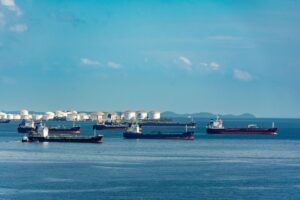
The update said empty Iran-flagged tankers are waiting at anchorages from Sri Lanka to Oman to Hong Kong because they cannot return to Iranian ports. It counted 20 off Sri Lanka and one off Duqm, Oman. It also reported clusters of vessels in a Malaysian anchorage despite action by Malaysian authorities.
The group said about 50 Iranian-flagged cargo vessels still operate across the Indo-Pacific, Indian Ocean, Red Sea and Mediterranean. It said several are under OFAC sanctions and some use falsified flag registrations near Karachi, Mumbai, Port Klang and Port Said. It also said war risk insurance pricing had already moved and that forward freight agreement futures reflected the tanker supply shock.
What it means for shippers
The report is from an advocacy organization, so shippers may want to check key figures against carrier advisories and IMO notices. Its operational points are still practical for anyone with cargo in the region.
- Transit times: The report says unescorted Hormuz passage should be treated as closed and that Cape routings add cost and time. Review delivery dates for cargo touching Gulf load ports.
- Insurance: It advises a review of war risk coverage for Gulf, Saudi and Red Sea cargo. Ask your broker about limits and exclusions before booking.
- Sanctions screening: It says cargo on or near Iran-affiliated vessels, or transshipped where they anchor, carries secondary sanctions exposure. Vet the vessel before confirming a booking.
- Surcharges: It ties high crude prices to bunker costs and surcharges, so budget for changes.
- Saudi routings: The report treats both sea and air routes as higher risk. Our guide on shipping from the USA to Saudi Arabia covers the basics, and carrier notices such as Maersk’s Hormuz update on line detention relief show how lines have handled equipment and free time in the region.